
Don’t miss the Head’s Blog
Lots of exciting news!
Areas of Learning
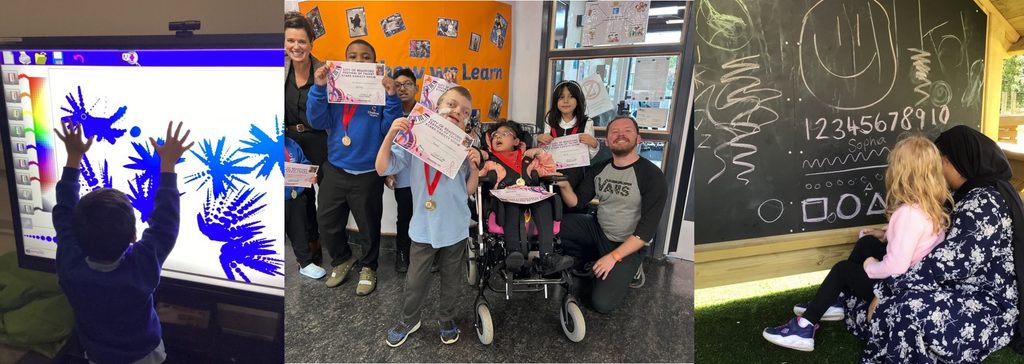
At Chellow Heights, our curriculum is holistic, highly personalised and tailored to the individual needs of every pupil.
We recognise that every pupil learns differently. Our curriculum builds on each child’s strengths, interests and existing skills while providing the appropriate support, challenge, repetition and opportunities to make meaningful progress.
Pupils follow a curriculum pathway that reflects their individual learning profile and developmental needs. These pathways provide different approaches to learning while maintaining high expectations for every pupil.
Our curriculum is organised around a two-year topic cycle, providing engaging contexts through which pupils can make meaningful connections between different areas of learning. Topics are adapted to ensure that all pupils can participate at an appropriate level, regardless of their starting point or pathway.
Communication and Interaction
Communication is central to learning at Chellow Heights and is embedded throughout the school day.
Pupils are supported to communicate their needs, wants, thoughts and feelings and to understand and respond to others. Communication may be developed through speech, signing, symbols, visual supports, communication aids, AAC and other personalised approaches.
Pupils are given regular opportunities to communicate during lessons, play, practical activities, social interactions, routines and community experiences.
English
Our English curriculum develops communication, reading, writing, vocabulary and self-expression.
Pupils experience stories, books, poems, rhymes and a range of other texts. Teaching is carefully differentiated according to individual ability and developmental level.
For some pupils, English may focus on early communication, listening, attention, vocabulary and pre-literacy skills. For others, it may include phonics, reading fluency, comprehension, spelling and writing.
Mathematics
Mathematics is taught through structured teaching alongside practical and everyday experiences.
Pupils develop understanding of number, quantity, calculation, shape, space, measure, pattern and problem-solving. Mathematical learning is applied to meaningful situations such as cooking, shopping, money, time and daily routines.
Science
Science provides opportunities to explore, investigate and develop an understanding of the world.
Pupils learn through practical, sensory and investigative experiences involving living things, materials, the environment and the natural world.
Understanding the World
Pupils develop their understanding of themselves, their families, communities and the wider world.
Learning includes history, geography, cultures, people, places, environments, the natural world and significant experiences. Learning may be extended beyond the classroom to provide real-life experiences and opportunities to apply knowledge.
Personal, Social, Health and Economic Education (PSHE)
PSHE supports pupils to understand themselves and others.
Learning includes relationships, emotions, wellbeing, personal safety, healthy lifestyles, rights and responsibilities, making choices and developing confidence.
For our pupils, PSHE also provides opportunities to develop self-advocacy, communication, independence and participation.
Physical Education and Physical Development
Physical development is an important part of the Chellow Heights curriculum.
Pupils have opportunities to develop movement, coordination, balance, strength, mobility and physical fitness. Activities are adapted to meet individual physical, sensory and developmental needs.
We aim to develop confidence, enjoyment and participation in physical activity.
Creative Arts
Art, music, drama, dance and other creative activities provide opportunities for pupils to explore, experiment and express themselves.
Creative learning supports communication, imagination, confidence, interaction and emotional expression and provides pupils with opportunities to demonstrate their individual strengths.
Computing and Digital Learning
Digital technology is used to support communication, learning, creativity and independence.
For some pupils, technology may be an important means of accessing the curriculum or communicating with others. Pupils are supported to use technology safely, appropriately and purposefully.
Independence and Life Skills
Developing independence is a key part of learning at Chellow Heights.
Pupils are provided with regular opportunities to develop practical skills such as:
These skills are taught explicitly where appropriate and reinforced through everyday routines and real-life experiences.
Learning beyond the classroom
Learning takes place across a range of environments. Pupils are given opportunities to apply their skills within the school, outdoors and, where appropriate, in the local community.
Using skills in different contexts helps pupils to understand their purpose and supports them to generalise and use their learning more independently.
Across all areas of learning, pupils work towards individual targets linked to their EHCP outcomes. Teaching may take place through whole-class lessons, small-group learning, individual teaching, practical activities, everyday routines, community-based learning and collaborative work with therapists and other professionals.